
Do you ever stop talking? Even for five minutes?
I'm still the same girl I was in middle school

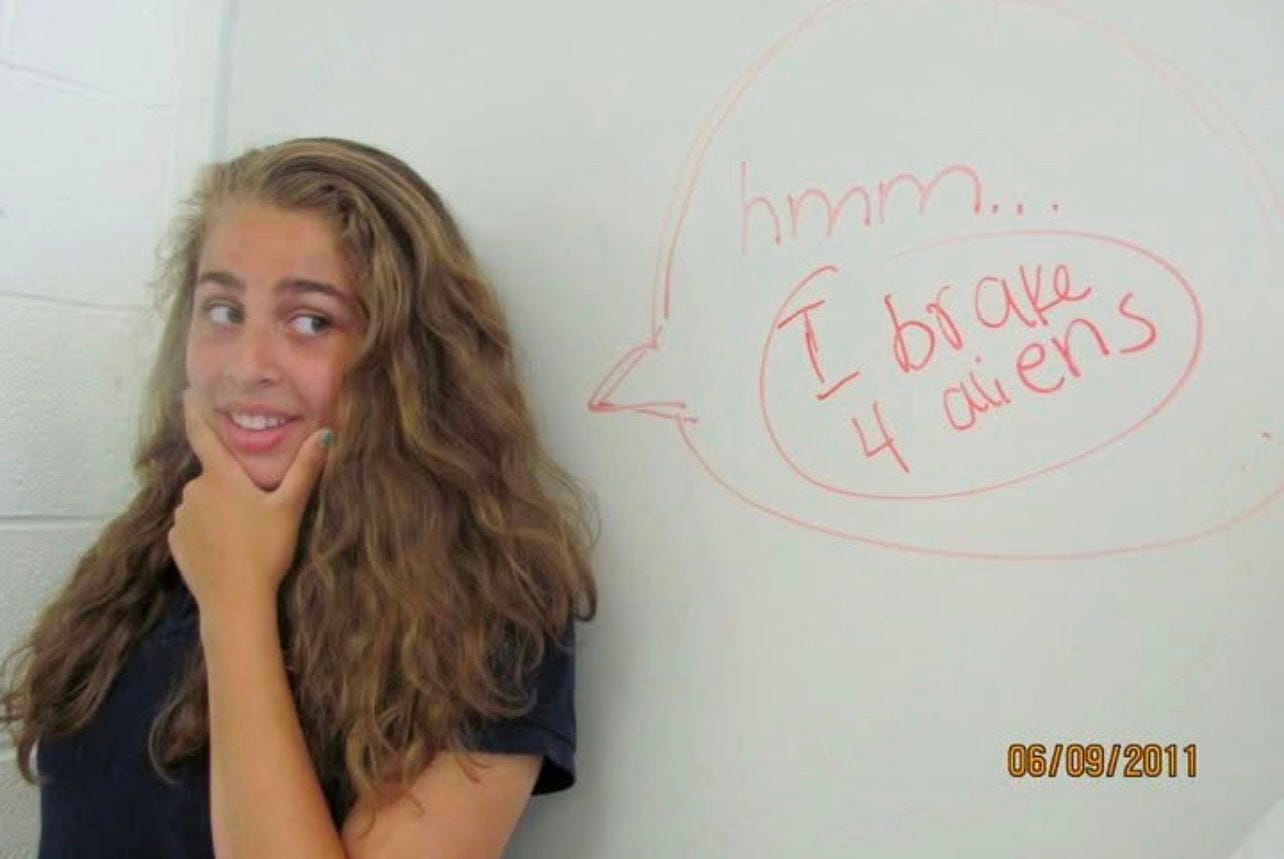
When I started the 6th Grade, I had just become thin for the second time in my life. The first period took place before I got my tonsils removed in Kindergarten, so it hardly counted, but still, I carried it as evidence that thinness, and so worth, were possible for me.
I had spent most of elementary school struggling to accept the fact that at worst, my fatness made me disgusting to others and, at best, invisible. I became adept at intuiting how others felt about me by studying the smallest facets of their behavior. Now in middle school, I believed myself acutely aware of the plights of others and I thought it my responsibility to advocate for the socially misfortunate. I was never in the business of excluding other kids, but now, several pounds down, I understood how the social capital of my thinness would allow me to do so without repercussion. In other words, I could use my thinness for good or for evil.
I had done okay so far in middle school. I wasn’t necessarily popular yet but, within a couple weeks, my teachers had taken a liking to me, my peers knew my name, and I even had one best friend, Marguerite. We had even become friends as easily as the movies said it would be: one day in Latin class, I didn’t have a pencil. She lent me one. And so we were friends.
But, most importantly, no one had known me when I was fat, and so the slate was clean.
One day, walking back from the lunch we had in the recreational room of the Greek Orthodox Church our new, hip public charter school resided in, one of our quieter classmates, Mica, joined Marguerite and I. She was a cute, mousy girl who didn’t speak much, but was a good student and would sooner collapse in on herself than be accused of being a disruption in class. As usual, when she joined us, she didn’t say much, but laughed at the appropriate times and made sure to smile often.
As we walked across the slightly-ragged courtyard back to the main part of the building to resume classes, I was doing my best work to make her feel comfortable, hoping that it would encourage her to open up and share more. I made jokes, riffed with Marguerite, and all but drained my social battery in an act of what I considered to be allyship: trying to include this shy girl and also draw her out of her shell—I would drag her, if I had to. I don’t remember much, except her laughing, smiling, and still barely speaking. I was waning, but I continued my effort—I knew what it felt like to be conditionally welcome, and I was determined to not carry on that tradition.
Marguerite’s path diverged for her homeroom, but Mica and I were in the same class, so we continued on together to retrieve our belongings for the next period. As I picked up my backpack, Mica turned to me and abruptly asked, laughing, “Do you ever stop talking? Even for five minutes?”
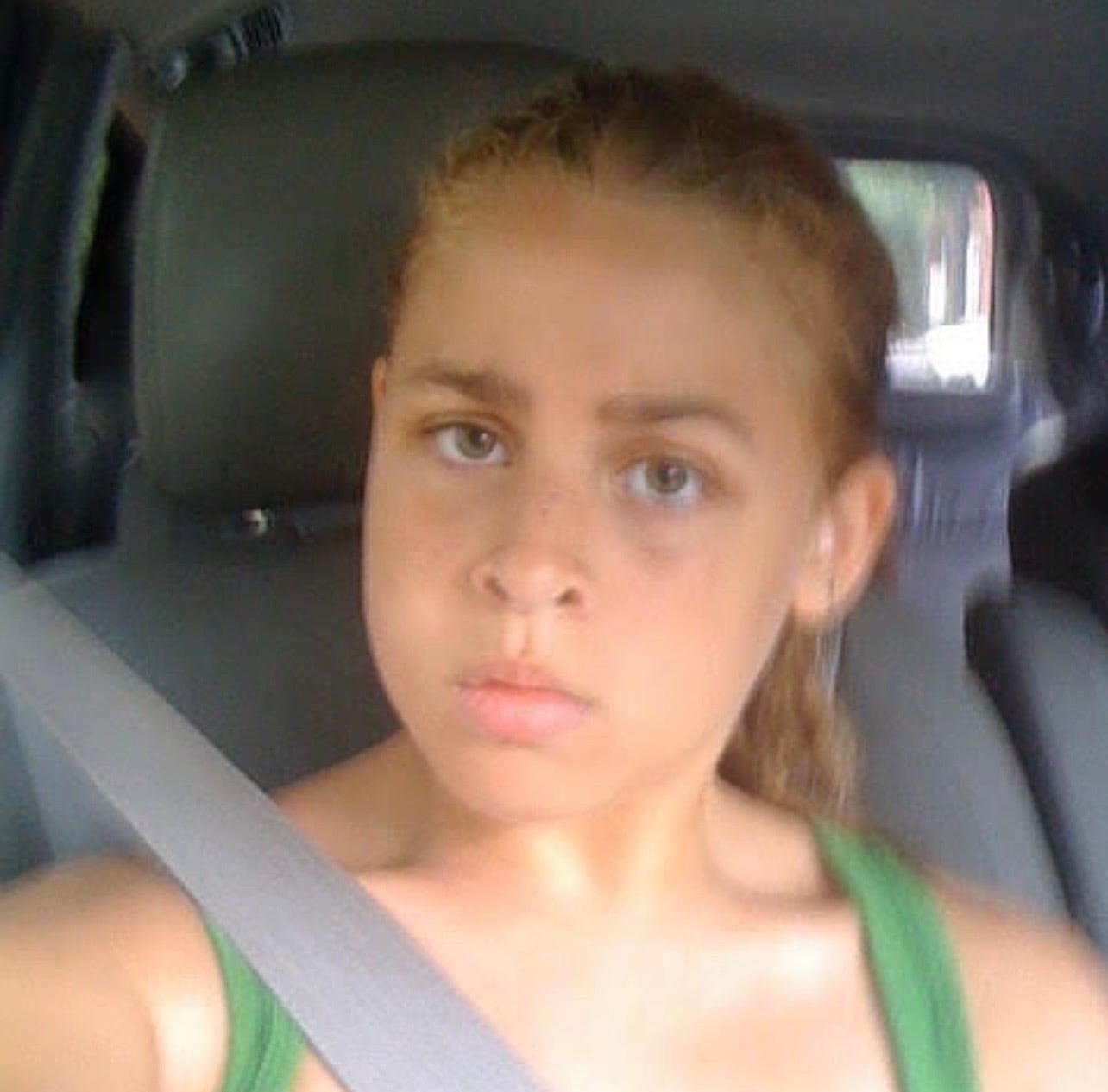
I was stunned—no, disgusted. I reacted instinctively and concisely; “That was really rude, Mica,” I replied. We had two years of middle school left. I never spoke to her again.
It didn’t occur to me then that I had projected my own insecurity onto her; that she was perfectly happy with her middle school career as it was going. It didn’t occur to me that aloneness was a fear unique to me, that signaled rejection in a way only specific to my lens. It didn’t occur to me that as bad as I felt for her, she may have felt the same but tenfold for me—this poor girl, who’s so afraid of being insignificant that she has all but forgotten how to shut the fuck up. Maybe I can put her out of her misery.
I don’t regret my response at all. In fact, I think it was remarkably mature for an 11-year-old. In fact, I think she’s actually lucky I didn’t rock her shit. While it was mortifying, I will admit I’m a little bit impressed at how intolerable 11-year-old me found disrespect, and even more so at how she unflinchingly let that be known.
Still, at twenty-seven, I find it annoyingly cliché how the things from our formative years stick with us. I find what it says about me even more grating.
The scariest part about the things that people say about you is their ability to embed themselves so deeply within your mind that you cease to be able to differentiate between what is you, and what is someone else’s perception of you. At age eleven, I just thought I was being nice. Now, however, that remark has been calcified in my brain as a fact of my personality: that I am, at least partially, a self-indulgent blabbering idiot (not what she said, but kind of exactly what she said).
But even scarier, really, is what resonates with you enough to become a part of you—a part you don’t even realize you’ve accepted until you find yourself trying to preemptively mitigate it in social settings.
Sometimes, now, when I’m having a long conversation with a friend, I start to get self conscious about how long I’ve been talking. I abruptly cut myself short, swallow any trail of the thought so that I won’t begin again. I think, but don’t say to myself, Do you ever stop talking? Even for 5 minutes?
Out loud I admonish myself: “Sorry! You know I could go on all day.” No one ever responds, “Yeah I was wondering when you’d shut the hell up!”, but I still brace myself for it.
Sometimes, I’m eleven again and I answer her.
Do you ever stop talking? Even for 5 minutes?
No. I don’t, I respond simply.
Other times I reply, I wish I knew how, and mean it.
Sometimes, on a good day, I say, Bitch, I was tryna help YOU out! Mica?! More like MEEK-A, silent film ass bitch!
There are moments when, in the middle of recording a video for TikTok or Instagram, I stumble over my words as her question permeates my mind. She’d hate to see what I’ve become, I laugh to myself. Or, She really was kind of right. And it’s embarrassing all over again, the concept of having pages and pages of evidence that someone’s scathing assessment of your personality was completely accurate.
I imagine her accidentally stumbling across one of my videos on her For You Page, and thinking to herself, Wow. She never did learn how to shut the fuck up.
I less frequently entertain the idea that she might be impressed at what I’d turned my disability—my inability to muzzle myself—into: a disengaged audience of a whopping 60,000. I suspect that in the event that she stumbles across my page, she’d consider me worse than someone who’s unable to clamp their jaws shut and let someone else speak—someone with nothing meaningful to say but who persists anyways.
People said plenty of unsavory things to and about me when I was growing up—it’s a fact of life, and more specifically, as 11-year-old Mica might tell you, a fact of being a woman who has a lot to say. But I didn’t hold each one of those remarks close to my heart. In the 9th Grade, a frenemy remarked that I looked like a “bleached Aunt Jemima”. I think about it sometimes, but I wouldn’t even know where to begin the process of integrating that into my sense of identity. People have said I look like Mariah Carey, and I never spontaneously transformed into an eight-octave singer. People investigate my ethnicity all the time—is she white? Is she Black? Is she an oddly colored white woman or an extremely light-skinned Black woman (a real question I’ve been asked)? And their assumptions never changed my understanding of who I am.
So when it comes to my propensity for excessive chatter, the depth with which that remark was able to embed itself within me always seemed to be proof of a dark truth. It stays with me because I know her question was somewhat valid, and even more terrifying: possibly earnest.
It’s not that my friends and loved ones today don’t know that I talk a lot, it’s just that I’ve found people gracious enough to accommodate me. One time, when I got together with my best friends, Gogo and Brian, for dinner, Gogo emerged from the kitchen to ask, “Do you guys want music?” We paused. “I was going to play some, but I know my bestie likes to talk!”
Hearing that, over a decade later, I didn’t feel slighted—I felt seen. I wasn’t a nuisance and, actually, I had won the lottery in finding friends who love me so much they’re willing to change the rules of social comfort for me.
So maybe Mica was more innocent than I allowed her to be. She was rude, but maybe it was just a bad joke. Maybe she was rude, but still right. Maybe she didn’t appreciate being assumed to be an underdog, so socially inept she needed not just a life vest, but a paddle and a board.
Maybe, in her refusal to talk more, she had simply never gone through the motions of talking so much that you eventually sharpen the skill of being able to bat your foot away before it can enter your mouth.